Development and Applications of Photodissociation
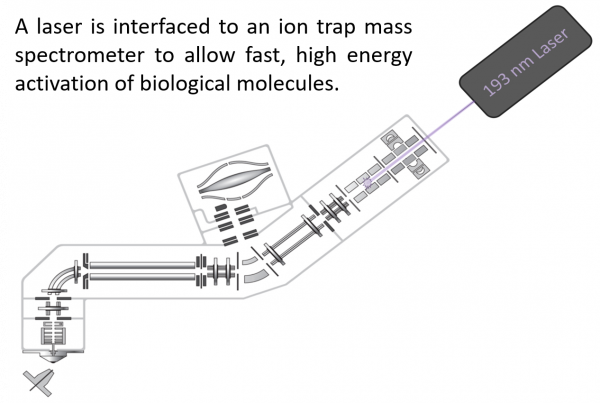
Despite the tremendous array of mass spectrometric tools which allow generation of large data sets, it has become clear that there remains a need for enhancing the selectivity of mass spectrometric strategies for problems involving complex mixtures or targeted screening while also offering versatility and tunability for other applications. Collision induced dissociation (CID) has the longest and richest history in the realm of ion activation methods, although its limited or poorly defined energy deposition has led to vigorous exploration of alternative strategies. Moreover, the sequence and charge state of biopolymers (like peptides, oligosaccharides, and oligonucleotides) can greatly influence dissociation. Newer techniques have shown promise both for widespread and niche applications, as well as offering complementary fragmentation patterns, more tunable energy deposition, or alternative dissociation mechanisms. We are developing IR and UV photodissociation (PD) methods and electron transfer dissociation (ETD), in conjunction with chemical derivatization methods that add chromophores and/or charge sites to molecules in order to modify ion fragmentation patterns. There are several key benefits of photodissociation that make a compelling case for continued development. For example, UVPD allows higher energy deposition (3 to 7 eV per photon depending on the wavelength) in a short time period (< 10 ns), allowing adaptation for fast, higher throughput applications. The ability to label molecules with IR or UV chromophores offers the ability to incorporate a high degree of selectivity into an MS/MS strategy. Our work is aimed at the structural characterization of biological molecules, especially proteins.
[Click An Image To Enlarge]
Surface Enhanced Desorption Electrospray Ionization Mass Spectrometry
We are developing a variety of surface-enhanced mass spectrometric strategies for sensitive, high throughput analysis of metabolites and biomarkers in dried blood spots and other biological matrices. Metabolomics, which encompasses the study of all small molecules found in tissues, cells, or biological fluids, presents a compelling frontier for exploration in a variety of health applications, including toxicology, pharmacology, physiology, the search for biomarkers of disease, and unraveling biochemical mechanisms of disease. The potential to monitor health status and the opportunity for early diagnosis of disease based on mapping biomarkers such as proteins, lipids, and metabolites has led to an increasing emphasis on the development of methodologies for rapid, high throughput identification of biological molecules in complex mixtures with high sensitivity and minimal sample consumption. In particular, the development of high throughput methods for rapid screening of mixtures to extract key information about targeted subsets of molecules remains a high priority in the metabolomics arena. In the context of the advances in mass spectrometric methods for metabolomics over the past decade, issues related to high throughput capacity, minimization of sample processing, enhanced selectivity, and high sensitivity remain top priorities. We are addressing these analytical challenges via the development of surface-enhanced desorption ionization tandem mass spectrometry for metabolomic and biomarker profiling. Our methodology combines ambient ionization (desorption electrospray ionization, DESI), a new robust ionization method, with selective surface chemistry to create a tunable extraction/desorption/ionization platform that allows the capture, enrichment, and mass spectrometric analysis of targeted compounds from biological matrices without the need for extensive sample processing or chromatographic separation.
Tandem Mass Spectrometric Characterization of DNA/Drug Interactions
Many of the most potent chemotherapeutic drugs, including the bioreductive prodrug aziridinylbenzoquinones, are alkylating agents that covalently bind to DNA and cause interstrand crosslinking of DNA. Although many of the specific mechanisms of anti-cancer compounds are still unknown, it is recognized that the basis for the activity of many anti-cancer agents is related to their ability to modify the structure of DNA,thus inhibiting DNA or RNA synthesis during DNA repair, replication, or transcription processes. We are developing sensitive, versatile analytical methods that can be used to determine the structures of DNA adducts, to evaluate the DNA sequence and site selectivity of alkylating agents, to efficiently screen reactivities of new alkylating agents, and to better understand the ways that alkylated DNA interacts with relevant proteins in a manner that leads to anticancer activities at a molecular level. Our synthetic organic collaborators are designing new analogues with fewer toxic side effects, and our goal entails the characterization of the new drugs, evaluating their relative reactivities with DNA, and determining the structures of the resulting DNA-drug adducts based on electrospray ionization tandem mass spectrometry. We are also developing footprinting and base-specific chemical probe reactions in conjunction with ESI-MS as a means to obtain specific information about drug binding sites and to assess distortions in DNA duplexes upon drug binding.
[Click An Image To Enlarge]